In the realm of fintech, the intersection of artificial intelligence and payment systems has sparked significant interest, yet a recent benchmark highlights a stark reliability gap that calls into question the readiness of many autonomous AI models for real-world applications. The findings from the ECOM1 benchmark, published through a collaboration between payments platform COLIBRIX ONE and innovation hub BitGN, reveal critical deficiencies in the performance of numerous AI agents when subjected to complex transactional environments. With over 1,000 engineers involved across 100 cities, the benchmark generated more than 1.6 million trials, offering a comprehensive view of how current systems fare in practical scenarios.
Performance Metrics Unveiled
The evaluation yielded disconcerting results: while leading AI architectures approached a commendable success rate of nearly 95%, the average performance of all participating systems hovered around just 20.2%. Even more alarming, the median success rate was a mere 2.4%, indicating that most efforts resulted in failure—roughly one successful task for every 42 attempts. This dramatic gap emphasizes the urgent need for a thorough understanding of how AI models can navigate the unpredictable landscape of live financial systems.
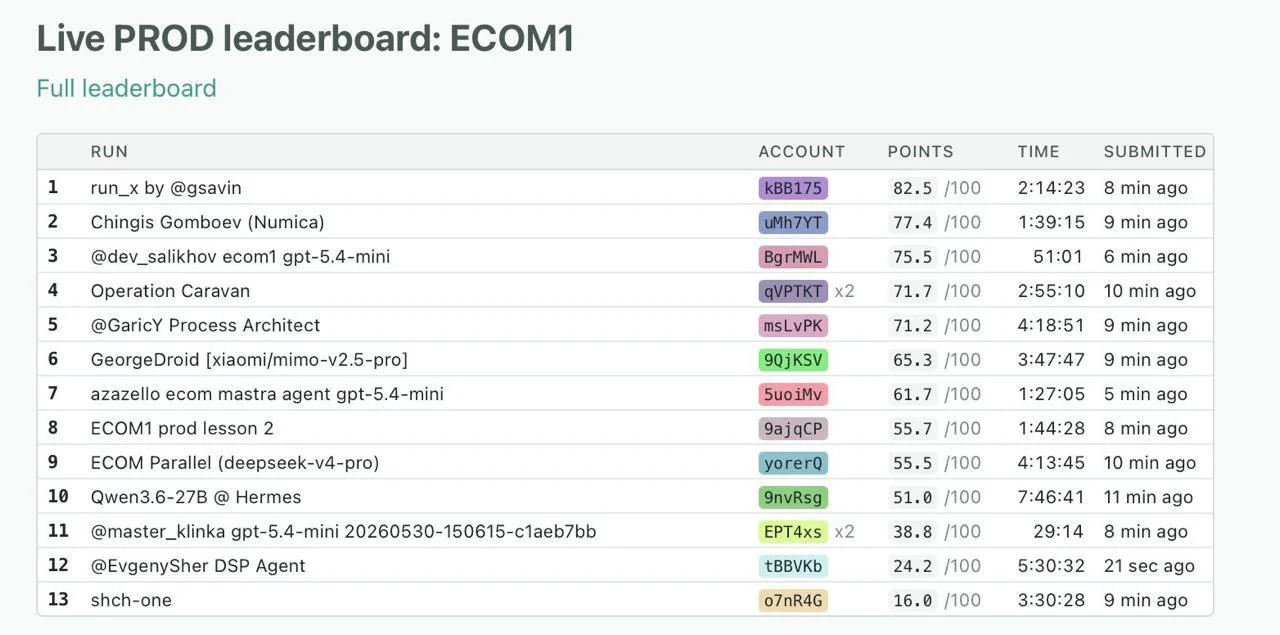
Trust Issues Over Technical Hurdles
The findings challenge the prevailing notion that technological limitations are the primary barrier to deploying these systems at scale. Instead, the data suggest that establishing deep operational trust is paramount. While modern large language models (LLMs) can generate impressive textual outputs or execute static commands, they falter under variable conditions inherent to financial transactions, such as fraud detection, compliance adherence, and customer interaction. The benchmark illustrated that the real test lies not in the ability to complete straightforward tasks but in managing the complexities arising from unexpected user behaviors or intricate regulatory requirements.
Critical Vulnerabilities Exposed
The benchmark's specific task analysis revealed operational areas where current AI technologies are particularly fragile. For instance, while executing approved promotional discounts, agents achieved only a 21.1% success rate. More convoluted tasks, like cross-customer 3-D Secure (3DS) recovery, dropped to 18.6%, and processing compliance updates fared even worse at 15.6%. Such performance metrics underscore a critical flaw in current AI models, which often depend on static, memory-based solutions that are inadequate for maintaining transaction integrity amid dynamic business environments.
A Roadmap for Future Development
Despite the disappointing results, the benchmark has provided valuable insights into the characteristics of successful systems. Elite architectures, such as Codex CLI and Claude Code, thrived under stress, but their efficacy hinged on specialized deployment strategies. Successful teams employed advanced models alongside well-defined sandboxes and execution controls, creating a governance framework that enabled AI agents to reason through complex problems while adhering to compliance protocols. This separation of cognitive flexibility and institutional safeguards is pivotal for financial institutions (FIs) aiming to integrate autonomous agents without risking systemic vulnerabilities.
Rinat Abdullin, founder of BitGN, emphasized the benchmark's conclusion regarding the disparity between average and top-performing agents. He pointed out that while technology has reached a point where fully automated agentic commerce is feasible, its realization requires meticulous tuning of engineering practices, robust testing, and unwavering commitment to operational discipline. Abdullin articulated that aligning AI systems with verifiable evidence and institutional policy is crucial, especially when consumers confront the system or unexpected challenges arise during transactions.
The Evolution of Payment Infrastructure
The insights gained from the ECOM1 benchmark are reshaping perceptions in the fintech community regarding AI's role in payment systems. Traditional gateways and risk management frameworks, primarily built on fixed rule engines, are increasingly viewed as inadequate in addressing the nuances of agentic commerce. As AI introduces adaptive, non-linear decision-making processes into the payment domain, FIs must adapt their systems to effectively incorporate autonomous agents. This evolution calls for the establishment of tailored sandboxes and verification protocols to enable real-time audits of AI agents before they initiate critical payment actions.
Looking Ahead: The ECOM2 Challenge
Building on the insights and participant feedback from the initial iteration, ECOM2 is poised to refine the industry’s approach. Instead of merely testing baseline problem-solving capabilities, the next phase focuses on evaluating the resilience of AI systems against real-world variabilities and constraints. ECOM2 will encompass complex compliance scenarios specifically designed for the fintech domain, alongside an expanded network of partners from various sectors, including payments, card issuing, and merchant acquiring.
The push for adaptable AI in financial applications is not just about optimizing performance but fostering a new era of trust and assurance in automated systems. The unfolding developments in the ECOM framework will likely influence how financial institutions redesign their infrastructures to integrate these advanced technologies effectively, ultimately paving the way for reliable and efficient AI-driven payment solutions.